
Coaching for Learning
Jacob's Second Workflow Book Recommendation

My husband Jacob says that he did not find Coaching for Learning to be life-changing in the way of Clean Your Room! Instead, he found that this book validated and elaborated on what he already knew, and for that reason I find it fascinating. While the tech world likes to draw its practices from Japanese culture, we classical education types pull from Plato, but golly, they sure do quack alike a lot of the time.
I have not read the entirety of Coaching, but I have thumbed through some of the sections that certainly have applications beyond software development:
Learning is knowledge creation, not knowledge transfer: “According to the latest neuroscience and modern thinking about learning, when you learn something new, you are creating new connections in your brain — not just moving knowledge around from one place to another. It’s a knowledge creation process, not a knowledge transfer process.” (p. 49)
There are terms within this quote with which I would quibble, but the overarching idea that learning must reach out of tightly siloed categories of facts stacks up for me.
It’s good to be a generalist: “What you’re trying to do with knowledge creation is level the playing field. No one’s ever going to be an expert in everything, but if you can increase the capabilities of everyone, then people don’t have to worry about self-identifying as the expert in a domain. Focus on building an organization populated with T-shaped people, those who are deep in one area and knowledgeable in many.” (p.50)
A liberal education is not primarily about getting a job, it is about becoming more fully human in all of the capacities and callings that human life entails. Do not be content with singly focused worker bees.
Tacit knowledge vs. Explicit knowledge: “The aim of a skillful performance is achieved by the observance of a set of rules which are not known as such to the person following them.” (p. 57 Quoted from Michael Polyani)
Wow! This one even has a name I recognize. In my curriculum development training Michael Polyani’s work was (and continues to be) discussed. The idea is that when the rubber meets the road, we do not fall back to a procedural check-list - not that those don’t have a proper place - so much as the automatic responses that settled deep into our physical body. As a dancer and a pianist, I know this as muscle memory, and it is so powerful that sometimes it is difficult to override when needed.
Teach for resilience: “Teams can be hesitant early on learning new practices or ideas. They often want more information before they get started. . .When you’re trying to get them to learn by doing, you must create an environment of safety. Let them know they don’t need to worry about doing it right, they just need to start doing it, and they’re going to learn by doing and experiment.” (p. 188)
This goes hand-in-hand with thinking iteratively, that is in a cycle of doing, evaluating, and doing again. I could wax on for pages about how far this process has gone toward breaking me of the perfectionism that kept me paralyzed for so much of my younger years. I tell my children and my students to go for it, do the best they’ve got right now, and learn from the outcome so you have more to give next time. That’s all there ever is for us mortals.

I want to give you something nice to look at. So far, this post looks a bit dry and geometrical. I mentioned quacking up above, so here is a picture of the baby ducks growing rapidly in our brooder.

Plato’s Meno
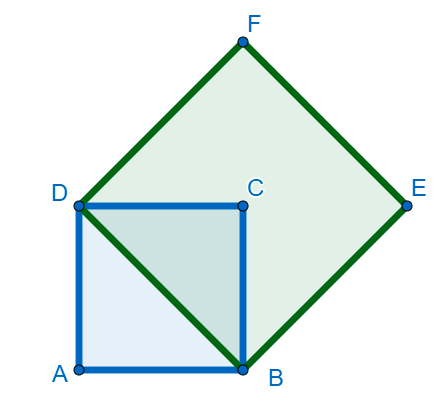
Many of the themes in Coaching bring Plato to mind. In particular, Plato’s Meno from my edition of Five Dialogues plays on the question of whether virtue can be taught. Socrates, the philosopher of Meno, is a bit cheeky about his method of causing a student to recollect what he already knows, and he asserts that such recollection is not teaching. Once you’re finished rolling your eyes at Socrates, you can read a little bit of his dialogue with his interlocutor Meno about how he caused an uneducated slave to recollect the relationship of the area of a square to the length of one of its sides. It is fun to follow Plato’s steps for this exercise with children about age ten.
Plato makes an important connection to resilience in the face of uncertainty. His student was made better by discovering his own ignorance. It’s not pleasant to encounter a gap, but it is the only real way forward:
Socrates: You realize, Meno, what point he has reached in his recollection. At first he did not know what the basic line of the eight-foot square was; even now he does not yet know, but then he thought he knew, and answered confidently as if he did know, and he did not think himself at a loss, but now he does think himself at a loss, and as he does not know, neither does he think he knows.
Meno: That is true.
Socrates: So he is now in a better position with regard to the matter he does not know?
Meno: I agree with that too.
Socrates: Have we done him any harm by making him perplexed and numb as the torpedo fish does?
Meno: I do not think so.
Socrates: Indeed, we have probably achieved something relevant to finding out how matters stand, for now, as he does not know, he would be glad to find out, whereas before he thought he could easily make many fine speeches to large audiences about the square of double size and said that it must have a base twice as long.
Mortimer Adler’s Socratic Seminar on Plato’s Apology
Mortimer Adler was a master of Socratic Dialogue, and listening to some of his seminars available on YouTube is a great way to gain a tacit knowledge of the process. There are so many great things about the video below. In addition to Dr. Adler’s methods, the conversation is aesthetically peaceful, thoughtful, respectful, and fun. The incredible ‘80’s fashion doesn’t hurt either. I did not find a seminar on Meno, specifically, but here is one on Plato’s Apology, which is another of the dialogues in my collection.